
The short answer
High-volume banqueting is an industrial process dressed as hospitality: it needs a kitchen designed for throughput rather than finesse, and it punishes every shortcut taken at the planning stage. Hotels sell weddings on the ballroom, the lawn and the price, then deliver them in a kitchen the family never sees. Whether designing new, retrofitting, or deciding what size of event an existing kitchen should be allowed to sell, the limiting questions are the same — production capacity, holding equipment, plating space and service route.
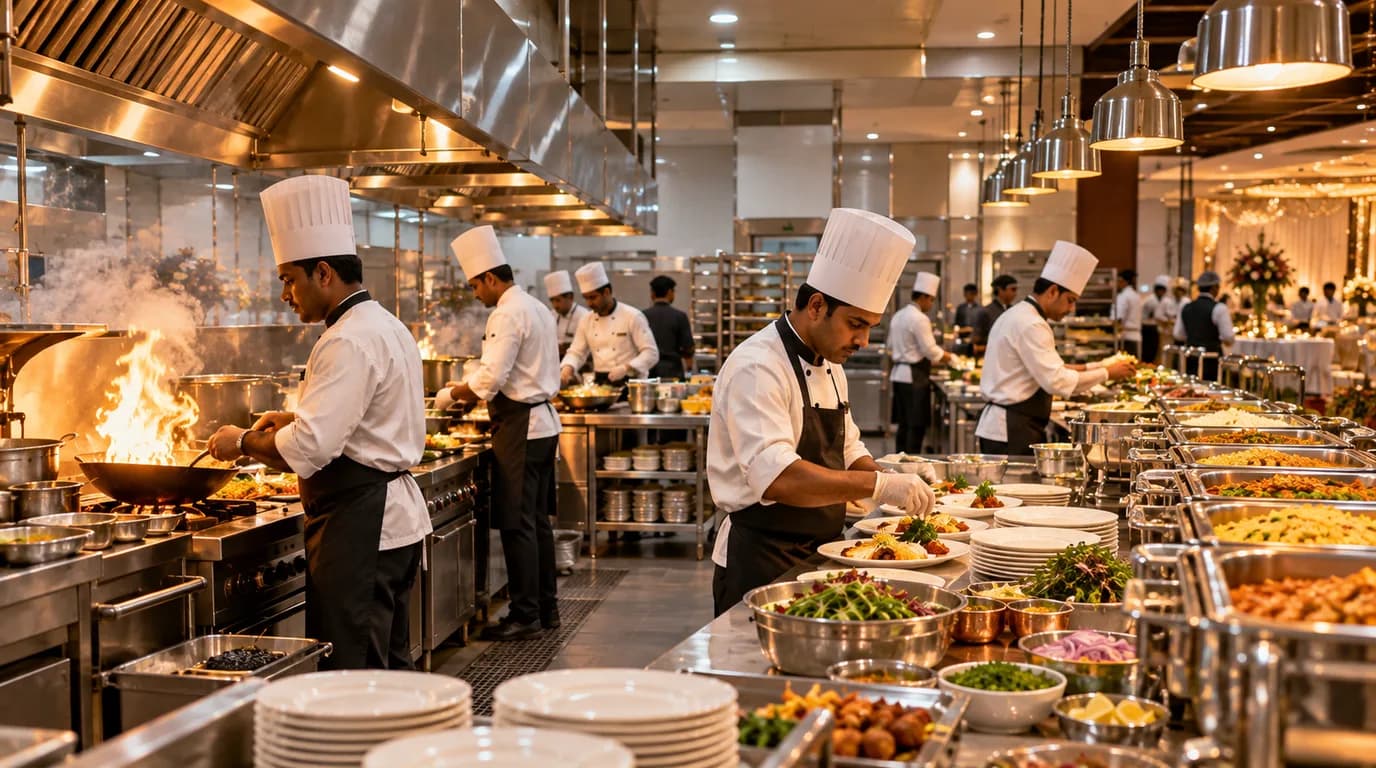
Indian hotels sell weddings on the strength of the ballroom, the lawn, the decor and the price. The event is delivered, or not delivered, in a kitchen that the family never sees and that the sales team rarely thinks about. The gap between those two facts is where a great many hotel reputations are quietly damaged — not by a hotel that could not sell a thousand-cover wedding, but by one that sold it and then could not physically produce it at temperature, on time, for three hours.
High-volume banqueting is an industrial process dressed up as hospitality. It demands a kitchen designed for throughput rather than finesse, and it punishes every shortcut taken at the planning stage. Whether you are designing a new hotel, retrofitting one, or deciding what size of event your existing kitchen should be allowed to sell, the questions are the same.
Size from the service window, not the cover count
The most common planning error is to think in covers. A thousand-cover wedding is not a capacity figure; it is a figure that becomes meaningful only when you attach a timeline to it. A thousand guests who graze across three hours at eight live counters and two buffet lines is a very different kitchen problem from a thousand guests served a plated dinner in forty minutes. Start with how the event is actually served — the sequence, the stations, the window in which the bulk of guests eat — and derive capacity from that. Everything downstream depends on getting this right, and it is the number sales most often leaves undefined.
Holding, not cooking, is usually the constraint
Ask where a banquet kitchen fails and the answer is almost never the range. Hotels buy cooking equipment generously. What they consistently undersize is everything around it: hot holding and bain-marie capacity, cold holding for the enormous volume of salads, chaats, desserts and garnishes an Indian wedding menu demands, blast chilling, and above all plating and assembly space. Food for a large banquet has to be produced in advance and held correctly — if there is nowhere to hold it at temperature, it is either cooked too early and deteriorates, or cooked too late and arrives in waves. Plan holding capacity as seriously as cooking capacity, because that is what determines whether the food that reaches the guest is any good.
Plan the live counters as part of the kitchen
Live counters are now an expectation rather than an upgrade, and they are frequently treated as a decor item placed wherever the layout allows. They are kitchen extensions, and they need the same thinking: power and gas supply at the right points, ventilation and extraction, water and waste where applicable, a safe path for replenishment that does not cross the guest flow, and a staff member per station who can cook in front of people. A counter without proper services becomes an extension cord across a walkway and a chef carrying hot oil through a crowd. Deciding the counter positions and their servicing at design stage costs nothing; retrofitting them is expensive and usually compromised.
Flow decides whether the room gets served
Banquet service is a logistics exercise. Food has to travel from production to holding to the point of service without crossing used crockery coming back, without passing through a guest area, and ideally without a change of level. The dish-wash return path has to be sized for the peak, because a thousand-cover event generates a volume of soiled crockery that will stop the entire service if the wash area cannot keep up — and the dish-wash area is the single most under-planned space in most hotel kitchens. Walk the route physically at the design stage with a trolley, and again before a big event, because a bottleneck that is invisible on a drawing becomes obvious at eight o'clock on a Saturday.
Separate the banquet kitchen from the hotel's
Any hotel doing serious banqueting volume needs a dedicated banquet kitchen with its own production, holding and wash capacity, positioned to serve the halls directly. Sharing the main kitchen means every large event degrades the restaurant, room service and breakfast simultaneously, and that trade-off always has to be made on the busiest nights of the year. A separate facility also allows the banquet operation to be staffed, managed and costed as what it is — a distinct high-volume business with different disciplines from à la carte dining. The capital case is usually straightforward in any hotel where banqueting carries a meaningful share of F&B revenue.
Discipline the menu before you sell it
The kitchen's capacity is set at design stage, but the load placed on it is set in the sales conversation. Families ask for long menus because long menus feel generous. The result is dozens of items, each requiring preparation, holding and service, with no improvement in guest satisfaction — guests sample a limited number of dishes regardless of how many are offered. A tighter, well-constructed menu delivered excellently reads as a better wedding than an enormous one delivered under strain. That requires a sales team briefed on what the kitchen can genuinely execute and confident enough to guide the family, which in turn requires the chef in the room when large events are being specified. The commercial logic of menu engineering applies to banquets as much as to a restaurant card.
Staff and brief the peak properly
Finally, the human plan. A high-volume wedding needs a staffing structure that is decided in advance: who runs production, who owns each counter, who controls holding and dispatch, who manages the pass, who supervises wash. Trained seasonal staff who have worked your banquets before are worth more than a larger number of new hires. And every department should work from the same event file — timings, covers, menu, counter positions, service sequence — because most banquet failures are communication failures that happened to show up in the kitchen.
Where to start this month
Before your next high-volume event:
- Define the service timeline for each event, not just the cover count.
- Audit holding, plating and chilling capacity against your largest sold event.
- Fix live-counter positions and services — power, gas, extraction, replenishment paths.
- Walk the food and dish-wash routes physically and find the bottleneck.
- Make the case for a dedicated banquet kitchen if banqueting is material to revenue.
- Set a maximum menu length the kitchen can execute, and brief sales on it.
- Write the staffing and briefing plan into the event file for every large booking.
A wedding is the most public thing a hotel does, and several hundred potential customers are watching. The kitchen is where it is won. If you want your banquet kitchen capacity and F&B planning reviewed against what you are actually selling, book a strategy call.
Owner's guides
Brand selection, pre-opening & feasibility playbooks — download instantly.
Frequently Asked Questions
Quick answers on banquet kitchen planning for high-volume weddings.
Work backwards from the service timeline, not from the cover count. Establish how many covers must be served in what window, how many live counters and buffet lines that requires, then check whether you have the cooking capacity, holding equipment, plating space, dishwashing throughput and staff to sustain it for that period. Most capacity failures are not about cooking — they are about holding, plating and washing.
Undersizing everything except the cooking range. Indian banquet menus are long, live counters are expected, and volumes are high, yet hot and cold holding, plating and assembly space, pot wash and dishwashing capacity are routinely planned for a fraction of what a full banquet night demands. The kitchen then works, badly, by spilling into corridors and service areas.
For any hotel doing serious banqueting volume, yes — a dedicated banquet kitchen with its own production, holding and dish-wash capacity, located to serve the halls directly. Sharing the main kitchen means a single large event degrades restaurant and in-room dining service simultaneously, and that trade-off gets made on exactly the nights the hotel is busiest.
Fewer than families usually ask for, and the sales team should be equipped to say so. Long menus multiply preparation, holding and service complexity without improving guest satisfaction, because guests sample a limited number of dishes anyway. A tighter menu executed excellently reads as a better wedding than a vast one executed under strain.

Written by
Rachit Goel
Founder & Principal Hospitality Consultant
Founder of The Hotel Adviser and a hospitality leader with 25+ years of hands-on experience across Marriott, Radisson, Ramada and Taj — spanning pre-opening, operations, revenue management and food & beverage.