
The short answer
Food cost in most Indian hotels should sit between 28% and 35% of food revenue depending on outlet mix, but it never stays where you left it — without a system it drifts upward a fraction of a percent at a time until month-end delivers a surprise nobody can explain. The fix is not heroics but a control loop that runs daily: par-based ordering, weighed receiving, standard recipes, portion discipline and a yield check against the P&L.
Two hotels can run identical restaurants, buy from the same mandi, and serve the same number of covers — yet one runs food cost at 29% and the other at 38%. The difference is rarely one big decision. It's a hundred small ones: an unweighed delivery here, a heavy-handed portion there, a vegetable order placed from memory instead of a par sheet.
In most Indian hotels, food cost should sit somewhere between 28–35% of food revenue depending on the outlet mix. The problem is that food cost never stays where you left it. Without a system, it drifts upward — quietly, a fraction of a percent at a time — until the month-end P&L delivers a surprise nobody can explain. The fix is not heroics. It is a control loop that runs every single day.
Start With Standard Recipes and Costed Cards
You cannot control what you have not defined. Every dish on your menu — from dal makhani to the banquet paneer tikka — needs a standard recipe card: exact ingredients, exact quantities, exact yield, and a cost worked out at current purchase prices.
Most hotels skip this because "the chef knows the recipe." That is precisely the problem. When the recipe lives in one person's head, every cook makes it differently, every plate costs differently, and you have no benchmark to measure against. Costed cards turn cooking into something you can audit. Re-cost them quarterly, or whenever a key ingredient — paneer, oil, chicken — moves sharply in price.
Lock Down Portions
A recipe card is useless if the plate doesn't follow it. Portion control is where theory meets the pass:
- Standard serving equipment — ladles, scoops, and bowls sized to the recipe, not to the cook's mood.
- Portion weights for proteins — a 160g chicken portion that becomes 200g on a busy night is a 25% cost overrun on that item.
- Pre-portioning during prep — weigh and pack proteins and expensive items before service, not during it.
Watch buffets especially. Refill in smaller batches towards the end of service; a full chafing dish at closing time is tomorrow's waste log entry.
Buy to Specification, Not to Habit
Purchasing is where the largest leaks usually start. Write purchase specifications for your top 20–30 ingredients — grade, size, trim level, packaging — and hold vendors to them. A "kg of chicken" means nothing; a "kg of skinless boneless breast, 150–180g pieces, chilled not frozen" is enforceable.
Then add vendor discipline: at least two approved suppliers per major category, rates compared monthly, and local sourcing wherever quality allows — seasonal vegetables bought close to source usually beat a consolidated city supplier on freshness and price. During monsoon, when vegetable prices spike and quality dips, this discipline decides whether you absorb the season or get mauled by it.
Control the Receiving Dock
Whatever you ordered, what matters is what arrived. Receiving is the cheapest control point in the chain — and the most ignored.
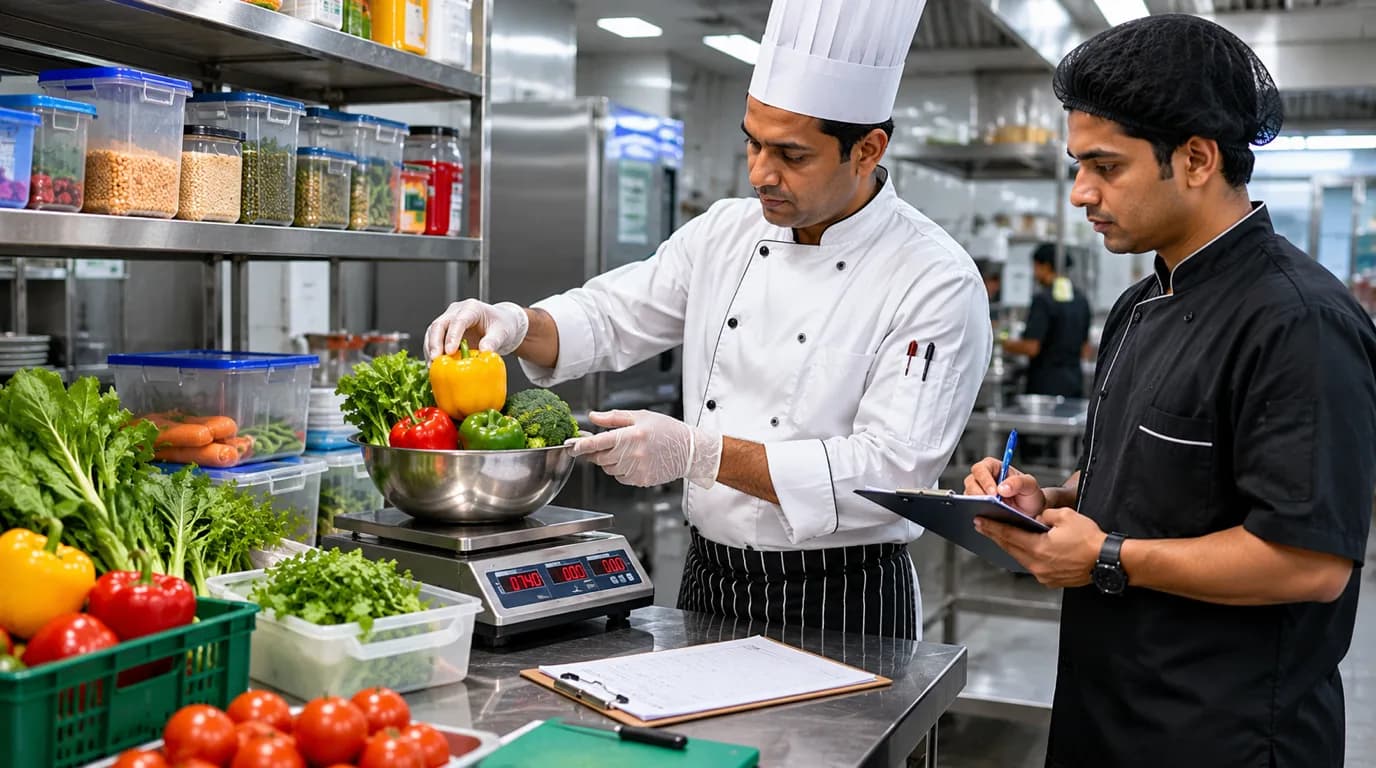
- Weigh everything. Every crate, every carton, against the challan. Short deliveries of even 3–5% compound into lakhs over a year.
- Check quality against your specs before signing — not after the vegetables are already in the walk-in.
- Separate the roles. The person ordering should not be the only person receiving. That separation alone deters most quiet leakages.
Store It Right, Rotate It Always
Storage losses are silent. Enforce FIFO (first in, first out) with date labels on every container — no exceptions, including the chef's "special" stock. Issue stores against requisitions, not open access, and spot-count your ten most expensive items weekly. Temperature logs for walk-ins protect both cost and food safety. Remember too that physical flow shapes loss — kitchen layout quietly determines how much food is damaged, double-handled, or forgotten between store and stove.
Track Food Cost Daily, Not at Month-End
A month-end food cost number is a post-mortem. A daily number is a steering wheel. Even an approximate daily flash — built from issues and purchases against the day's food revenue — tells you within 24 hours when something has gone wrong, while the trail is still warm.
Pair it with a waste log: every kilo of spoiled, burnt, returned, or over-prepped food, written down with a reason. Within a month, the log shows exactly where money is leaking — rarely where the chef assumed.
Manage Menu Mix and Respond to Inflation Without Cutting Quality
Not every item needs the same food cost. A 40% cost on a high-priced sizzler can contribute more rupees than a 25% cost on a cheap sandwich. When guests drift towards low-margin items, adjust placement, pricing, and upselling rather than panicking about the percentage.
When input costs rise — and in India, they will — resist shrinking portions or downgrading ingredients. Guests notice both, and reviews follow. Instead: re-engineer recipes, rebalance the veg/non-veg mix (vegetarian items typically carry better margins), renegotiate vendor terms, and take selective, confident price increases on items with low price sensitivity. This is exactly where an outside expert review pays for itself many times over — a structured F&B consultancy engagement will typically find 2–4 percentage points of recoverable food cost in a hotel that has never been audited.
Start This Month
- Cost your top 20 selling items with proper recipe cards at current prices.
- Install weighing and challan-checking at receiving — every delivery, no exceptions.
- Start a daily food cost flash and a written waste log.
- Write purchase specs for your 20 biggest ingredients and get two vendors quoting on each.
- Review the numbers weekly with your chef and F&B manager — same day, same time, every week.
Food cost control is not a project you finish; it is a rhythm you run. If you want help building that rhythm in your hotel — and finding the margin you're currently leaking — book a 30-minute strategy call and we'll go through your numbers together.
Owner's guides
Brand selection, pre-opening & feasibility playbooks — download instantly.
Frequently Asked Questions
Quick answers on how to control food cost percentage in hotels: a step-by-step system.
Between 28% and 35% of food revenue depending on your outlet mix. The problem is that it never stays where you left it — without a system it drifts upward a fraction of a percent at a time until month-end delivers an unexplained surprise.
With standard recipe cards for every dish: exact ingredients, quantities, yield and a cost worked out at current purchase prices. Most hotels skip this on the basis that the chef knows the recipe, and you cannot control what you have not defined.
With serving equipment sized to the recipe rather than to the cook's mood — ladles, scoops and bowls — and portion weights for proteins. A 160g chicken portion that quietly becomes 200g on a busy night is where the recipe card stops mattering.
Because what matters is not what you ordered but what arrived, and receiving is the cheapest control point in the chain and the most ignored. Weigh every crate and carton against the challan — short deliveries of even 3-5% compound into lakhs over a year — and check quality against written specifications.
No. A month-end number is a post-mortem; a daily number is a steering wheel. Even an approximate daily flash built from issues and purchases against the day's food revenue tells you within 24 hours when something has gone wrong, while the trail is still warm.

Written by
Rachit Goel
Founder & Principal Hospitality Consultant
Founder of The Hotel Adviser and a hospitality leader with 25+ years of hands-on experience across Marriott, Radisson, Ramada and Taj — spanning pre-opening, operations, revenue management and food & beverage.