

The short answer
Payroll is the largest controllable cost in almost every Indian hotel and the one most often managed by instinct — a headcount and a comparison to last year, rather than productivity per occupied room or labour cost per occupied room. That gap is where several points of margin live. With high sector attrition and scarce trained talent, the instinct to solve service problems by adding people now meets a market that cannot supply them, which makes productivity the only remaining lever.
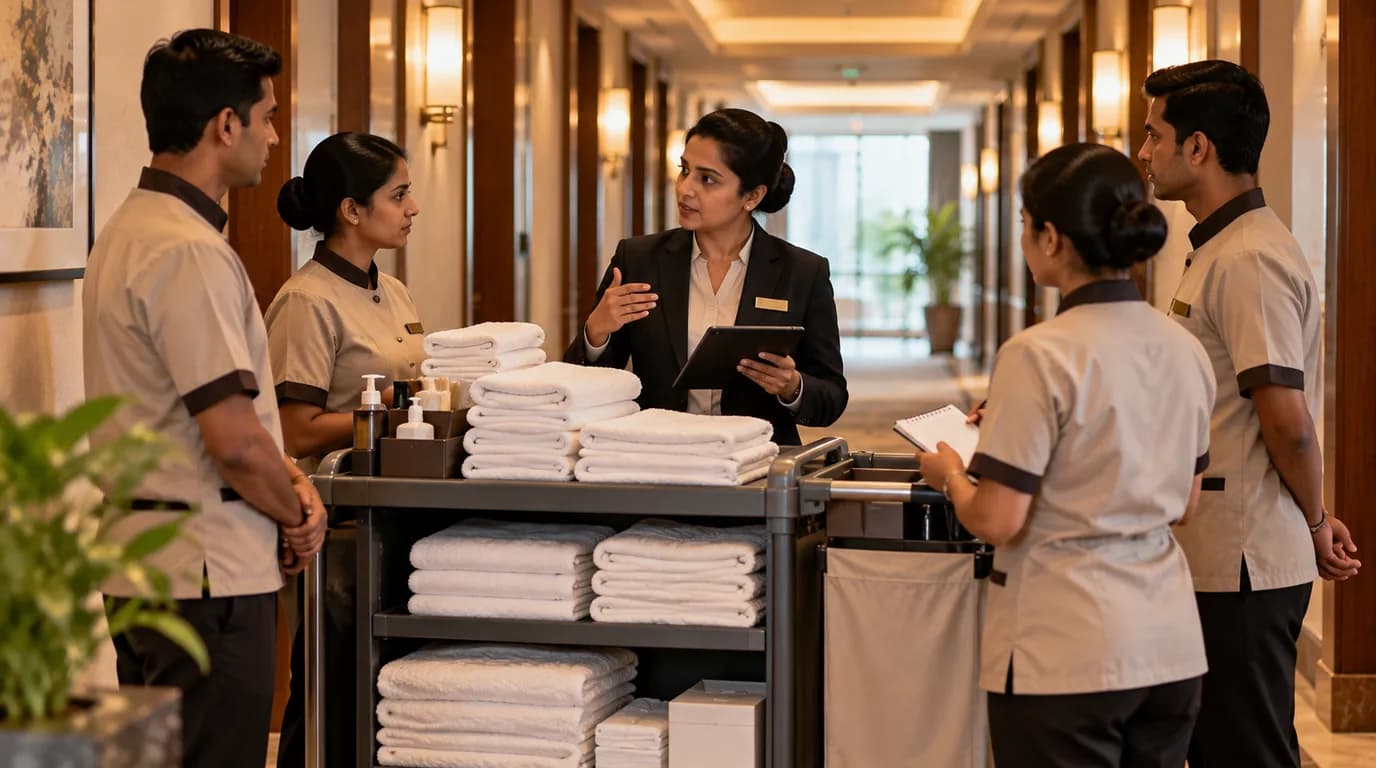
Payroll is the largest controllable cost in almost every Indian hotel, and it is the one most commonly managed by instinct. Ask a general manager how their manpower cost is doing and you will usually get a headcount and a comparison to last year. Ask what their housekeeping team's productivity is, or what a labour hour costs them per occupied room, and the answer is far less often to hand. That gap is where several points of margin quietly live.
It matters more now than it used to. Finding and keeping trained hospitality staff in India has become genuinely difficult — attrition across the sector is high, trained talent is scarce, and a great many hotels are operating meaningfully below the headcount they consider ideal. In that environment, the instinct to solve service problems by adding people runs into a market that cannot supply them. The alternative is to get more out of the team you can actually recruit and retain, which is a productivity problem rather than a hiring problem.
Ratios are a sanity check, not a target
Staff-to-room ratios are useful and widely misused. They vary enormously by segment and service model: a budget hotel with a lean front desk and outsourced housekeeping runs a fraction of the ratio a full-service luxury hotel with multiple restaurants, a spa and banqueting carries. Indian hotels have historically operated with higher ratios than comparable Western properties, for reasons of labour cost and service expectation that are perfectly rational. So a ratio only tells you something when it is compared to hotels of the same segment, with the same outlets, the same banqueting load and the same outsourcing model. Benchmarked against the wrong peer group it produces confident, wrong conclusions.
Build a manning plan from the work
The more rigorous approach is to build staffing from the work the hotel actually has to do, department by department. How many rooms need cleaning at the occupancy you forecast, at what credit per room attendant, across how many shifts? How many covers does each outlet serve at each meal period, and what does that require at the pass and on the floor? What does the banqueting calendar demand, and when? How many arrivals and departures cluster at which hours, and what does that mean for the front desk? Done properly, this produces a manning plan that moves with the business rather than a fixed establishment that is overstaffed in August and underwater in December.
Measure productivity, not just cost
Cost per department tells you what you spent. Productivity tells you what you got for it. The handful of measures worth tracking weekly are not complicated: rooms cleaned per attendant shift, total labour hours per occupied room, covers per F&B labour hour, and payroll as a percentage of departmental revenue. Each one exposes something a headcount cannot. A housekeeping department whose cost looks fine but whose cost per occupied room is drifting upward has a productivity problem that will keep getting worse. Measured consistently, these numbers also give heads of department something to improve, which is far more productive than an instruction to reduce headcount.
Flex the layer, protect the core
Indian hotel demand is spiky — festival weeks, wedding dates, long weekends, conference seasons — and a flat permanent establishment is the wrong shape for it. The structure that works is a core permanent team sized for the base business, surrounded by a flexible layer: contract staff, trainees from local hotel schools, part-timers, and crucially a rehire pool of people who have worked your peaks before. The hotels that handle a compressed wedding season well are the ones calling back the same banquet team they used last year, already trained and already familiar with the property. Those recruiting strangers the week before a peak are buying a service failure.
Outsource deliberately, not reflexively
Outsourcing housekeeping, laundry, security, landscaping or stewarding can be sensible, and it can equally be a way of moving a problem off the payroll line and into the guest experience. The honest test is whether the function requires guest-facing judgement and brand knowledge. Back-of-house and specialised functions often outsource well. Core guest contact rarely does. And outsourcing changes the cost but not the management burden — a contracted team still needs standards, supervision and training, and a hotel that outsources to avoid managing people usually discovers the cost in its reviews.
Multi-skilling is the realistic answer to scarcity
Where trained staff are genuinely hard to find, cross-training is the highest-return investment available. A front-desk associate who can handle reservations, a steward who can serve, a housekeeping supervisor who can cover the desk at a quiet hour — each adds resilience and reduces the number of bodies required to cover a given set of shifts. It also makes jobs more interesting, which matters because the departure reasons people give most often are a lack of growth and a lack of variety. Multi-skilling is, usefully, both a productivity measure and a retention measure.
Retention is a productivity measure
The arithmetic of turnover is unforgiving. Every departure costs recruitment effort, training time, a period of reduced output, and usually a dip in service while the gap is covered. A hotel with high attrition is permanently paying to bring people up to speed, which is why its productivity never improves regardless of how tightly it manages headcount. Treating staff retention as a cost-control strategy rather than an HR nicety is one of the few genuinely free wins in hotel operations — the team that stays gets better at the work, and better teams need fewer people.
Where to start this month
To manage manpower by productivity rather than headcount:
- Benchmark your ratio against the right peer group — same segment, same outlets, same outsourcing.
- Rebuild the manning plan from the work, department by department, at forecast volumes.
- Start tracking four productivity measures weekly and share them with heads of department.
- Separate your core team from the flexible layer and build a rehire pool for peaks.
- Review every outsourced function against whether it needs guest-facing judgement.
- Pick three cross-training pairs and run them this quarter.
- Measure attrition by department and treat it as a productivity number.
The hotels that will cope with a tight labour market are not the ones with the biggest teams. They are the ones who know what their team produces and have built the work around it. If you want a review of your manning plan and productivity measures before next year's budget locks, book a strategy call.
Owner's guides
Brand selection, pre-opening & feasibility playbooks — download instantly.
Frequently Asked Questions
Quick answers on staffing ratios and productivity: getting manpower right in an indian hotel.
It varies enormously by segment and service model. Budget and economy hotels typically run well under one employee per room, midscale around one, and full-service luxury properties considerably more. Indian hotels have historically carried higher ratios than Western equivalents, partly because of labour costs and partly because of service expectations. The ratio is only useful compared against hotels of the same segment and service model.
Most Indian hotels land somewhere between the high teens and around thirty per cent of total revenue, depending on segment, service model and how much is outsourced. A number at the top of that range is not automatically wrong if the hotel is full-service and performing, and a low number is not automatically good if service is failing. What matters is the trend, and whether the cost is tracking volume.
Productivity. Headcount tells you what you are paying for; productivity tells you what you are getting. Measures like rooms cleaned per housekeeping shift, covers served per F&B staff hour, and total labour hours per occupied room reveal whether a department is genuinely efficient, and they let you flex staffing with demand instead of cutting posts and hoping.
Build a core permanent team sized for the base business, and a trained, repeatable flexible layer — contract staff, trainees, part-timers and a rehire pool — for peaks. The hotels that cope with festival and wedding spikes are the ones that keep the same seasonal people coming back, because they are already trained. Recruiting strangers a week before a peak date is what produces service failures.

Written by
Rachit Goel
Founder & Principal Hospitality Consultant
Founder of The Hotel Adviser and a hospitality leader with 25+ years of hands-on experience across Marriott, Radisson, Ramada and Taj — spanning pre-opening, operations, revenue management and food & beverage.