

Every October, hotels across India start the same ritual. Spreadsheets get opened, last year's numbers get copied into a new column, a growth percentage gets applied, and a document called "next year's budget" gets emailed to the owner. By the end of the second quarter, nobody refers to it any more. The hotel is running on monthly forecasts, the budget sits in a folder, and the whole exercise has produced nothing except a number the owner is disappointed about.
That is a waste of the most useful planning window a hotel gets. A budget done properly is not a prediction — it is the one time each year when the entire management team has to agree, in writing, where the business is coming from, what it will cost to deliver, and what the owner can expect. Done well, it sets the commercial direction and the cost discipline for twelve months. Done as a copy-paste exercise, it sets nothing at all.
Start with the calendar, not last year's number
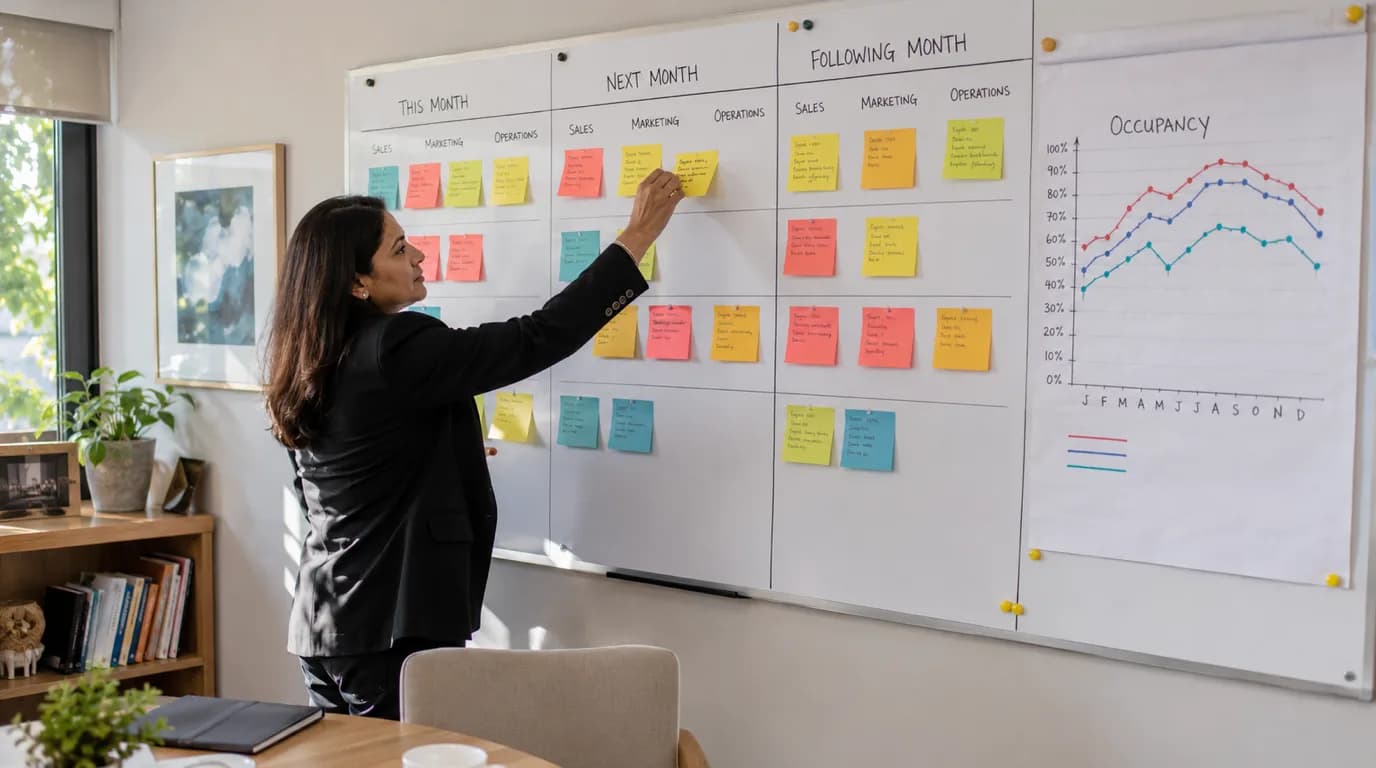
The first mistake is anchoring on last year's total. Begin instead with next year's calendar, because a hotel's year is shaped by specific dates, not by a smooth trend. Which months carry the wedding dates, and how many are there? When does the corporate travel cycle peak and when does it go quiet? Where do the long weekends and festival clusters fall, and are they better or worse placed than last year? When is the monsoon going to flatten your leisure demand? Mapping the year before you touch a number tells you where the opportunity and the exposure actually sit — and it will often show that a flat year-on-year total requires a very different month-by-month plan.
Build revenue segment by segment
Revenue should be built from the bottom up, one segment at a time, for each month. Corporate and retail, contracted and dynamic, OTA and direct, groups and MICE, weddings and social, crew and long-stay — each has its own volume logic and its own rate trajectory. You know roughly how many room nights your top corporate accounts produced and whether those contracts are being renewed up or down. You know what your OTA production looks like in a given month. You know how many banquet dates are realistically sellable. Add those up and you get a revenue number you can explain and defend. Apply eight percent to last year and you get a number you cannot. The same segment-level discipline that drives good weekly decisions is what makes an annual budget credible.
Make the rate assumption explicit
The single most consequential line in a hotel budget is the rate assumption, and it is usually the vaguest. Be specific: which segments are you planning to take rate in, by how much, and on what basis? Rate growth that comes from genuinely stronger demand, a renovated product, or a better channel mix is a plan. Rate growth that exists only because the budget needed to balance is a hope, and it will be the first thing to break. Equally, be honest where rate has to be defended rather than grown — a market absorbing new supply next door is not a market where you push ADR by double digits.
Budget the costs that actually move
Cost budgeting tends to go wrong in the opposite direction: every line gets a small inflationary bump and nothing gets examined. The lines that matter are the ones with scale. Payroll is the largest controllable cost in almost every Indian hotel, and it needs to be built from an actual manning plan — positions, seasonality, overtime, and the contract labour you genuinely intend to use — not from last year plus an increment. Energy, food and beverage cost, laundry, commissions and distribution costs, and repairs all move with volume, so they should be budgeted as ratios against the business they support, not as flat annual figures. And every ratio you set becomes a target somebody has to hit, which is the point.
Put capex and the reserve in the plan
A budget that only covers operations is half a plan. Hotels consume themselves: soft furnishings, mattresses, kitchen equipment, air-conditioning plant, lifts, and IT all have replacement cycles, and the year you ignore them is the year an emergency replacement blows a hole in your cash flow. Set out next year's planned capital spend item by item, and fund the reserve properly. Owners who treat capex as an annual surprise end up with tired hotels and falling rate; owners who plan it keep the asset competitive and the budget honest.
Agree it with the owner before it is final
A budget becomes real when the owner and the operating team have argued about it and then agreed. That conversation is where the assumptions get tested, the owner's expectations get calibrated against what the market will actually give, and the trade-offs get made in daylight — more marketing spend for more direct business, a renovation that costs this year and pays next. A budget delivered as a fait accompli gets reopened in month four. One that has been genuinely negotiated holds, because both sides own it.
Then manage against the forecast
Finally, accept what a budget is for. It is the annual commitment and the cost framework; it is not the tool you run the hotel with day to day. That is the rolling forecast, revisited every month against what demand is actually doing. The budget tells you whether you are on track for the year; the forecast tells you what to do next week. Hotels that confuse the two either keep managing to a number that stopped being true in February, or abandon the budget entirely and lose all cost discipline.
Where to start this month
To build a budget that survives the year:
- Map next year's calendar first — wedding dates, festivals, corporate cycles, monsoon.
- Build revenue bottom-up by segment and month, never as a percentage of last year.
- State the rate assumption explicitly and justify it from demand, product or mix.
- Build payroll from a real manning plan and the volume-linked costs as ratios.
- Budget capex and the FF&E reserve item by item, not as an afterthought.
- Agree it with the owner in a working session before it is signed off.
- Set the monthly review rhythm that will keep correcting it all year.
The hotels that end next December close to plan are rarely the ones with the cleverest spreadsheet. They are the ones that spent October asking harder questions. If you want an experienced second pair of eyes on your budget assumptions before they are locked, book a strategy call.
Owner's guides
Brand selection, pre-opening & feasibility playbooks — download instantly.
Frequently Asked Questions
Quick answers on hotel budget season: building an annual plan that survives the year.
Hotels on a calendar-year budget should start in October and finish by early December, so the plan is agreed before the year begins. Hotels on an April–March financial year should use October for a serious mid-year reforecast and start the next year's budget in December or January. Either way, four to eight weeks of real work is the minimum — budgets built in a week are guesses.
Bottom-up, then sense-checked top-down. Build revenue segment by segment and month by month from real demand logic — corporate contracts, OTA production, wedding dates, group business — then compare the total against last year and the market to see whether it is credible. A budget that starts as a growth percentage applied to last year is not a plan; it is an aspiration.
Expect the annual total to land within a few percent if the assumptions were honest, but do not expect individual months to be right. Seasonality shifts, wedding dates move, and corporate demand changes. The budget's job is to set the direction and the cost discipline; the monthly forecast is what you actually manage against.
The owner or asset manager, after a working session with the general manager and the heads of department who have to deliver it. A budget handed down without that conversation gets quietly disowned the first month it is missed, and a budget the owner has not interrogated will be reopened mid-year anyway.

Written by
Rachit Goel
Founder & Principal Hospitality Consultant
Founder of The Hotel Adviser and a hospitality leader with 25+ years of hands-on experience across Marriott, Radisson, Ramada and Taj — spanning pre-opening, operations, revenue management and food & beverage.