
The short answer
Front desk upselling is the cheapest incremental revenue in a hotel: no construction, no new hires and no software, just a structured conversation at check-in while the guest is already at the desk. For a 25–300 room property, a programme that actually runs converts empty suites, open spa slots and celebration add-ons into meaningful lakhs a year.
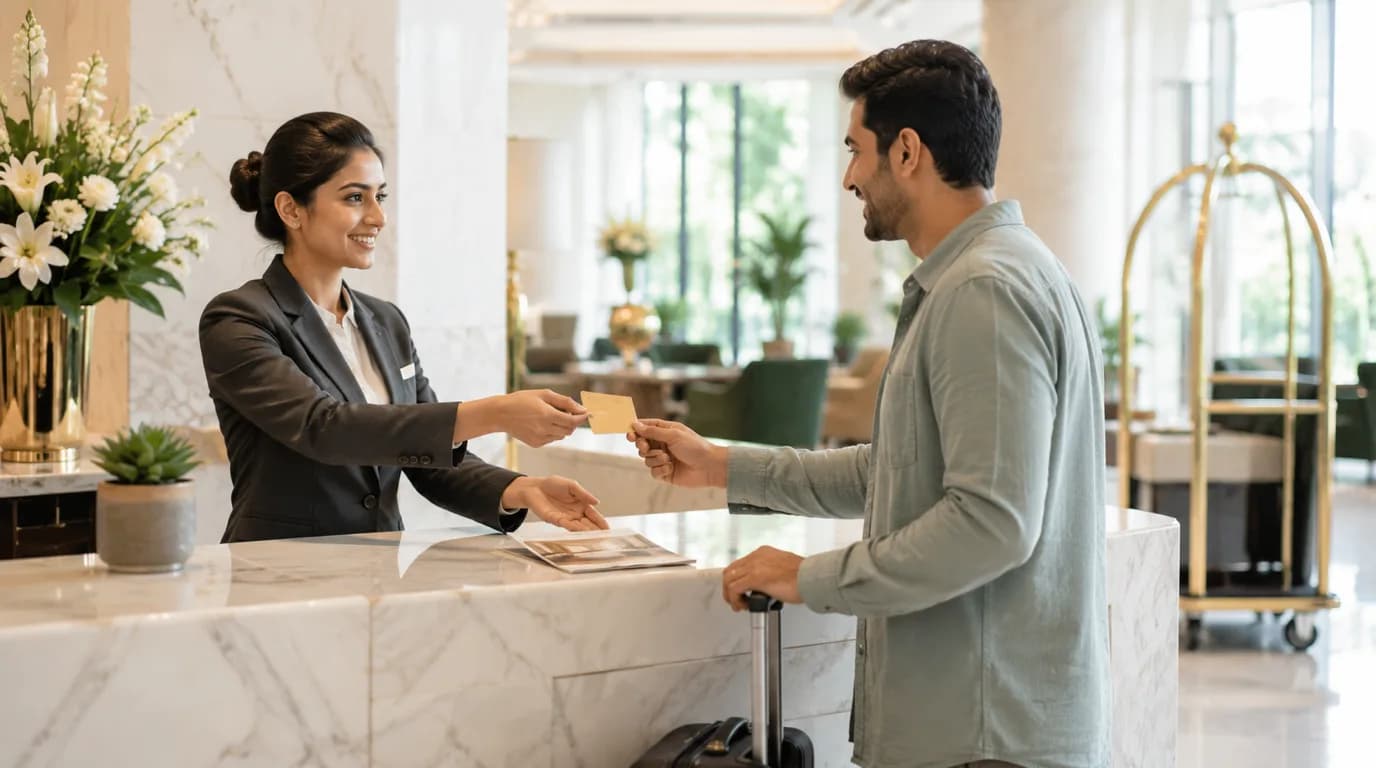
Walk past your front desk during the evening check-in rush and count the conversations. Rooms are assigned, IDs are copied, keys are handed over — and not one guest is offered anything. Meanwhile, two floors up, your best suites sit empty, the spa has open slots, and the kitchen could plate twenty more celebration cakes a month if anyone asked.
This is the cheapest revenue in your entire hotel. No construction, no new hires, no software purchase — just a structured conversation at a moment when the guest is standing in front of you, wallet already open. For a 25–300 room property, a working front desk upselling program typically adds meaningful lakhs per year. Here is how to build one that actually runs.
See What Is Already Sitting at the Desk
Start by listing what you can sell at check-in today, with zero capex:
- Room upgrades — base category to club room or suite, sold at a fraction of the rack difference rather than left vacant.
- Early check-in and late checkout — guests landing on 6 a.m. flights will happily pay for a guaranteed room.
- F&B add-ons — breakfast for room-only bookings, dinner buffets, cake and decoration for celebrations.
- Airport transfers — especially for OTA guests who booked room-only.
- Celebration packages — anniversaries, birthdays, proposals; in the Indian market this demand is constant and badly underserved.
Most properties already have all five. What they lack is a system for offering them. This is the front-desk slice of total revenue management — the discipline of earning from the whole property, not just the room rate.
Understand Why It Fails Without a Program
Telling the team "please upsell" achieves nothing, and it is worth being honest about why:
- No scripts. Staff don't know what words to use, so they say nothing.
- No incentives. The receptionist earns the same whether she sells ₹0 or ₹50,000 of upgrades this month. Why would she risk an awkward moment?
- Fear of seeming pushy. Indian front office teams are trained to be deferential; unstructured selling feels like a violation of hospitality.
Upselling fails as an instruction and succeeds as a program. The next four sections are the program.
Build 3–4 Sellable Offers With Fixed Prices
Do not give the desk a menu of twenty options. Give them three or four, each with a set price agreed in advance:
- Upgrade to club room: ₹1,500 per night
- Guaranteed late checkout till 4 p.m.: ₹800
- Breakfast added for two: ₹900
- Celebration setup (cake, décor, photo): ₹2,500
Fixed prices remove hesitation. The agent is not negotiating; she is offering a defined product, the same way a barista offers a larger cup.
Write Scripts That Frame the Guest's Benefit
The script is what kills the "pushy" fear, because a good script is a courtesy, not a pitch. The formula: observe, offer the benefit, state the price, accept either answer gracefully.
"Mr. Sharma, I see you're with us for three nights. I can move you to a club room on a higher floor with a king bed for just ₹1,500 a night — would you like that?" Ten seconds. If he says no, "No problem at all, sir" and check-in continues. Rehearse these in a weekly fifteen-minute role-play until they sound natural, not recited.
Share the Upside With the People Selling
This is non-negotiable. If the hotel keeps 100% of upsell revenue, the program dies in three weeks. Pay a fixed incentive per conversion — commonly 10–15% of upsell value or a flat per-sale amount — settled monthly and celebrated publicly. The economics are unbeatable: you are paying a small commission on revenue that otherwise did not exist, far cheaper than the 18–25% you pay an OTA for the room itself.
Track Conversion Per Agent, Per Shift — and Coach Weekly
What gets measured gets sold. Keep a simple register or PMS field: arrivals handled, offers made, conversions, value. Review it weekly:
- Offer rate — is every eligible arrival actually being asked? This is usually the first leak.
- Conversion per agent — pair your best converter with strugglers; her phrasing is your real script.
- Revenue per arrival — your headline metric for the program.
Treat that last number with the same seriousness as your room metrics — and make sure you are reading it correctly, the same way you separate RevPAR vs ADR instead of mixing them up. Incremental revenue per arrival is the honest measure; total upsell revenue alone hides weak offer rates on busy shifts.
Pre-Sell Before the Guest Arrives
The desk converts better when the guest has already seen the offer. Send a short arrival email or WhatsApp 24–48 hours before check-in: upgrade, late checkout, transfer, celebration package — with prices and one-tap replies. Some guests buy instantly; the rest arrive pre-warmed, and the desk's ten-second script lands on familiar ground. This matters most for OTA guests, where the pre-arrival message is often your first direct relationship with someone MakeMyTrip or Booking.com has kept anonymous.
Start This Month
- Pick your 3–4 offers and fix their prices — upgrade, late checkout, breakfast, celebration package.
- Write and rehearse ten-second scripts for each, framed as guest benefit.
- Announce the incentive scheme — a defined share per conversion, paid monthly.
- Start the per-agent, per-shift tracking sheet from day one.
- Switch on a pre-arrival offer message for all bookings, OTA included.
A front desk that sells is built, not born. If you want help designing the offers, scripts and incentive structure for your property, book a 30-minute strategy call and we will sketch your program together.
Owner's guides
Brand selection, pre-opening & feasibility playbooks — download instantly.
Frequently Asked Questions
Quick answers on front desk upselling: the ancillary revenue most hotels leave at check-in.
Room upgrades from base category to club or suite, sold at a fraction of the rack difference rather than left vacant; early check-in and guaranteed late checkout; breakfast added for the room; and celebration setups such as cake, decor and photos.
Because the programme is missing. Staff have no scripts so they say nothing, no incentive so the receptionist earns the same whether she sells ₹0 or ₹50,000 of upgrades, and no measurement so nobody knows whether eligible arrivals were even asked.
Three or four, each with a price agreed in advance — for example an upgrade to a club room at ₹1,500 a night, guaranteed late checkout until 4 p.m. at ₹800, breakfast for two at ₹900, and a celebration setup at ₹2,500. Fixed prices remove hesitation at the desk.
Yes, or the programme dies within weeks. A fixed incentive per conversion, commonly 10-15% of upsell value or a flat per-sale amount, settled monthly and recognised publicly. The economics strongly favour paying it.
Offer rate — whether every eligible arrival was actually asked, which is usually the first leak — plus conversion and value per agent and per shift, reviewed weekly so strong converters can coach the others.

Written by
Rachit Goel
Founder & Principal Hospitality Consultant
Founder of The Hotel Adviser and a hospitality leader with 25+ years of hands-on experience across Marriott, Radisson, Ramada and Taj — spanning pre-opening, operations, revenue management and food & beverage.