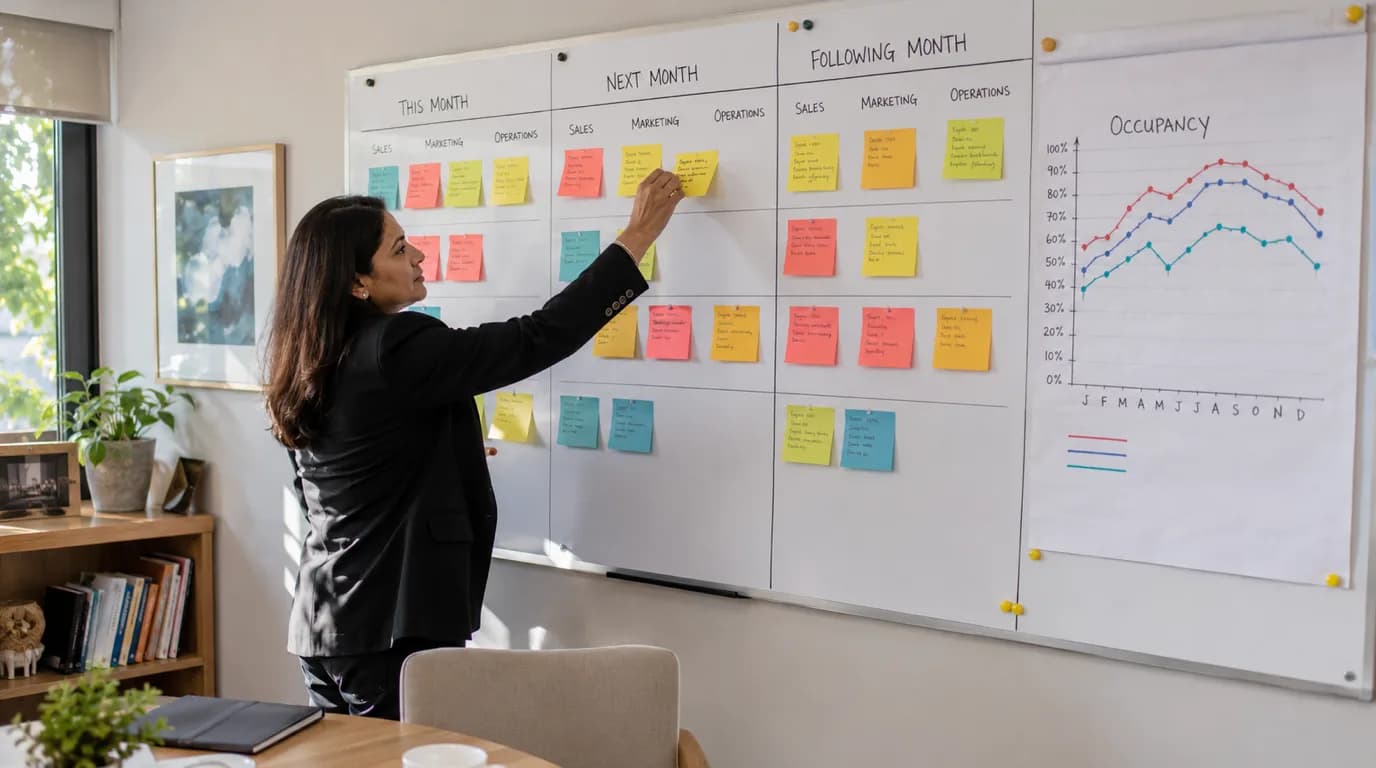


Walk into most hotel revenue meetings and you will find the same ritual: someone reads out last week's occupancy, everyone nods, a few numbers are compared to last year, and the meeting ends without a single decision that changes what happens next. It feels productive because data was discussed. But a meeting that only reviews the past is a status update, not a revenue meeting — and it moves RevPAR by exactly nothing.
A revenue meeting earns its place on the calendar only if people leave it having changed something: a rate for a specific date, a restriction on a high-demand night, a decision to chase a segment, an action to fill a soft week. The difference between the two kinds of meeting is structure and discipline, not seniority or software. Here is how to run the kind that actually moves the number.
Look forward, not back
The single most important shift is to spend most of the meeting on the future, not the past. Last week's results are context; they cannot be changed. The decisions that move RevPAR are all about the days, weeks, and months still on sale. A useful rule: no more than a quarter of the meeting on what happened, the rest on what to do about what is coming. Revenue management is a continuous discipline, and the meeting is where that discipline gets applied to the forward book.
Bring the right people and the right pace
A revenue meeting needs the general manager, the person who owns pricing, and the head of sales — the three people who can actually commit to a decision. It does not need a large audience. Keep it to a defined weekly slot, keep it tight, and protect it; the moment it becomes optional or gets cancelled for firefighting, the forward view goes stale and the hotel drifts back to reactive pricing.
Read demand, not just occupancy
Occupancy tells you how full you are; it does not tell you whether you are pricing correctly. A night that is 90% full three weeks out is probably underpriced. A night that is 30% full a week out needs demand, not a lower rate. The meeting should look at the pace of bookings for each future period — how fast the rooms are filling compared to normal — and price to that pace. This is the same forward-looking view that a 30/60/90-day forecast provides, turned into weekly action.
Decide by date, not in general
Vague decisions produce no results. "Let's push the weekend" changes nothing; "raise the rate on the 14th and 15th because the pace is strong and there's a wedding in town, and open a two-night minimum" changes revenue. Work the calendar date by date for the high-demand and soft periods, and make specific, assignable calls. The output of the meeting should be a short list of concrete rate and inventory actions, each owned by someone.
Align sales and pricing in the same room
The most expensive mistake in revenue management is sales and pricing working in opposite directions — the sales team chasing group business on the exact nights the hotel could sell at full rack rate, or discounting into a period that was already going to fill. Bringing both into one meeting means group and contract decisions are made with the demand picture visible, so you accept the business that fills troughs and decline the business that displaces higher-value rooms.
Close every meeting with owned actions
A revenue meeting that ends without a written action list will repeat the same conversation next week. Finish with a short, specific list — the rate changes, the restrictions, the segments to chase, the soft dates to attack — each with a name against it. Then open the next meeting by checking whether last week's actions happened and what they did. That loop, week after week, is what compounds into a higher RevPAR.
Where to start this month
To turn your revenue meeting from a review into a driver:
- Flip the ratio — spend most of the meeting on the forward book, not last week.
- Fix a weekly slot with the GM, pricing owner, and head of sales, and protect it.
- Look at booking pace by future period, not just current occupancy.
- Make date-specific decisions on rate and restrictions, not general intentions.
- Decide group and contract business in the same room, against the demand picture.
- End with a written, owned action list and review it at the start of the next meeting.
The meeting itself is free; the discipline is what costs effort — and what pays. Run it forward-looking, specific, and accountable, and RevPAR follows. If you want help setting up a revenue rhythm that sticks, book a strategy call.
Owner's guides
Brand selection, pre-opening & feasibility playbooks — download instantly.

Written by
Rachit Goel
Founder & Principal Hospitality Consultant
Founder of The Hotel Adviser and a hospitality leader with 25+ years of hands-on experience across Marriott, Radisson, Ramada and Taj — spanning pre-opening, operations, revenue management and food & beverage.